Tuesday, May 30, 2023

Manipulation


  1. Key concepts 

Building 


  1. Possibility requirement of the shapes 

  • Two trapezoid 
  • Six squares 
  • 4 rectangles


  1. Utility of the shapes 

  • Trapezoid is used for building the roofs of house 
  • Constructing tables 
  • Constructing chairs 


  1. Result / output


1.Key Concept: Tree


2.Possibility requirement of the shape 

  •    16 triangles 
  •     2 squares 


3.Utility of the shapes 

  •    Triangles : To makes roofs 

                     While constructing bridges 

  •     Squares: To make grids 

                    To make tiles

                    It is used in almost every design as a base or a frame to give it a sense of  

                    stability.


4. Result / output 


Lesson Plan using Coogle.it


Construction of Angles

 Using a protractor in manipulative, construct following angles: 

  1. Right angle triangle - 90°


  1. Obtuse angle - 110°


  1. Straight angles - 180°


  1. Acute angle - 60°


  1. Reflex angles ( between 180-360°)


Monday, May 29, 2023

Situating Tool

Rhombus 

Concept Skills

Rhombus is a geometric shape that falls under the category of quadrilaterals. It is a parallelogram with four sides of equal length. The defining characteristic of a rhombus is that all its sides are congruent, meaning they have the same length.

Key concepts related to a rhombus include:

Sides: A rhombus has four sides, and each side is of equal length. The sides are parallel to each other in pairs.

Angles: The opposite angles of a rhombus are equal. Since a rhombus is a parallelogram, its opposite angles are congruent.

Diagonals: The diagonals of a rhombus bisect each other at right angles. This means that the point where the diagonals intersect divides each diagonal into two equal segments.

Symmetry: A rhombus has two lines of symmetry, passing through the intersection of its diagonals. This means that if you fold the rhombus along either of its lines of symmetry, the two halves will perfectly coincide.

Properties shared with parallelograms: A rhombus shares some properties with parallelograms. These include opposite sides being parallel, opposite angles being congruent, consecutive angles being supplementary (adding up to 180 degrees), and consecutive sides being congruent.

Relationship to other shapes: A rhombus is a special type of parallelogram, meaning it possesses all the properties of a parallelogram. It is also a special case of a kite, another quadrilateral with two pairs of adjacent congruent sides.

Process Skills 

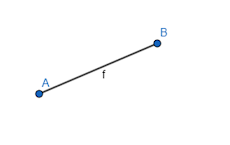
Step 1: I used the line segment and created a diagonal line with point A and point B.

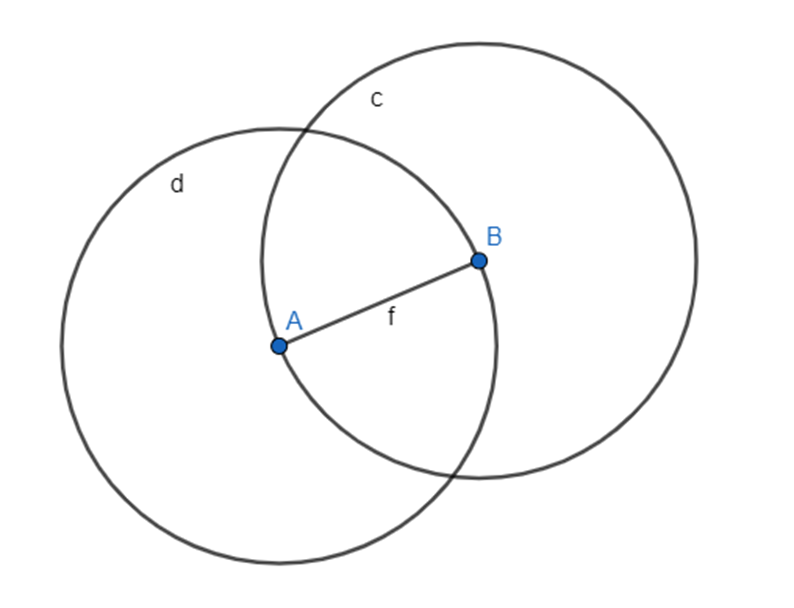
Step 2: I used compass, clicked point A and B to make a circle where point B was at the center.


Step 3: Again I used compass, clicked point B and point C to make a circle where point A is a the center.


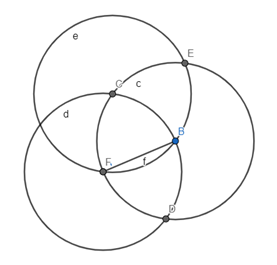
Step 4: Then I used intersect to find the point C.


Step 5: To find the point E I used compass, clicked point A and point C and made a circle. Then using the intersect, I marked point E.

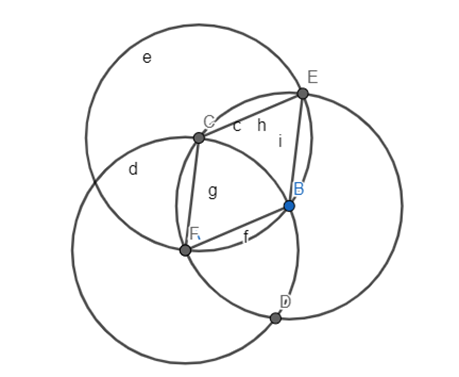
Step 6: Next, I used line segment to join point A, B,C and E.


Step 7: Lastly, using the polygon, I completed the shape rhombus. 


Product skills 


Positive Utilities (Values) and Real-World Applications of Learning about Rhombus:

  • Geometry Understanding: Learning about the properties and construction of a rhombus enhances geometric understanding and spatial reasoning skills.
  • Problem Solving: Understanding rhombus properties helps develop problem-solving skills by applying geometric concepts to real-world situations, such as calculating areas and perimeters of rhombus-shaped objects or designing structures with rhombus components.
  • Art and Design: Rhombus shapes are commonly used in art, architecture, and design. Understanding the properties of a rhombus allows for the creation of aesthetically pleasing patterns and structures.
  • Engineering and Construction: Knowledge of rhombus properties can be applied in engineering and construction projects, where rhombus-shaped structures or components are used, such as diamond-shaped windows, roof trusses, or diamond-shaped supports.
  • Jewelry and Crafts: Rhombus shapes are often used in jewelry and crafts. Understanding the properties of a rhombus helps in creating and designing unique and visually appealing pieces.
  • Mathematical Applications: The study of rhombus is connected to various mathematical concepts, such as symmetry, trigonometry, and coordinate geometry. Understanding rhombus properties can facilitate learning in these areas and their applications in real-world problem solving.
By exploring and applying the concept, process, and product skills related to rhombus construction in GeoGebra, learners can develop a deeper understanding of geometry and its practical applications in the real world.


Wednesday, May 3, 2023

Balanced Diet


Digital Citizenship

 1. Nine elements of digital citizenship 


2.  The role of teachers in digital citizenship are;

  • Providing the authentic information 
  • Create awareness to the learners about the dangers while using technology 
  • Letting learners take active role in digital world
  • Educating the learners about the elements of digital citizen

3. The digital rights and responsibilities, I should carry out as a teacher are 

  • Right to access and use technology to for teaching 
  • Rights to create and share digital media to teach 
  • Right to report anyone or anything that seems inappropriate 
  • Right to use digital content to educate the learners 

Responsibilities are : 

  • Using appropriate language when communicating  through technology 
  • Obey the intellectual property laws
  • Making learners aware of the appropriate use of others work with permission 
  • Responsible in making report of cyber bullying threats and inappropriate use of digital resources 
  • Protecting others privacy 


4. Since today's youth are digital natives, they are adept at using technology in many different ways. Now that technology is a part of their daily existence, I have observed that some young people are using it wisely to the point where it has given them opportunities. For instance, many teenagers are interested in video blogging, creating YouTube accounts, making music videos, and many other inventive activities. However, some people are suffering as a result of technological developments due to improper use of digital devices. This is primarily due to the fact that most young people are not conscious of digital citizenship. I believe it is crucial that parents and teachers start teaching kids about digital citizenship at an early age.


Sunday, April 30, 2023

Assistive Technology


1. Interview Questions and Answers

  • What types of assistive technology are there for the inclusive education?

           Assertive tools are basically categorized as low tech and high tech.

  •   What is low tech assistive tool and what are some of the examples?

           Low teach are the assistive technology that is simple enough where it can be made using the                    local  resources for instance reading stand and pen holder.

  • What is high tech assistive technology and what are some of the examples?

           High tech assistive technology is the intense and expensive form of technology for instance-                   controlled wheel chair, iPad and computer.  

  •  Which type of assistive technology is used more?

          Low tech is mostly used than high tech.

  • Why is high tech assistive technology not used commonly?

        The core reason is because high tech assistive technology is expensive that is why it is not easy to            purchase it. With that we also lack specialist who have a good knowledge on operating such                    high- tech assistive technology.

  • Do you think assistive technology is applicable in every school?

          Application is limited because the obstacle is in applying theory into practical.

  • If assistive technology is expensive, then how can I as an educator help the special needs children?

         You can use alternatives such as integrating low tech assistive technology and incorporate some               improvisation to cover the gap of high-tech assistive technology.

  • What are some of the assistive technologies used here?

          Stress ball

          Fidget spinner

          Picture communication file

          Reading stand

           Arm Glider

          Writing Stand 

  • What new changes should be introduced to improve the inclusive education?

        We need some specialist who can train teachers in inclusive education. It would be grate if we                 also  have all the assistive technology particularly high tech to cater the needs of special children.

  • What plans are there in the future to take inclusive education in the next level?

        A new project will be launched to start a diploma for teacher assistance who can help a teacher in the classroom to assist the teacher in monitoring activities and supporting the special needs.

2. What are some of the challenges faced in teaching special needs children.

The main challenge is the shortage of teacher due to which the special needs children do not get the intended support in education. With that the admission of the special needs children is quite difficult as they need extra support and attention. Special children should have a caregiver and they need different facilities that are not always available in most of the school.  Moreover, most of the teachers are not trained in the inclusive education so without a good experience they also face difficulty in catering the special needs children. Even if there are facilities and teacher, emotionally it is hard to convince them the normality of their disability as they are given more preference than the other students which makes them feel different and insecure. 

                                        Assistive Technology available in Rinpung


Classroom Schedule                                                              Weather Board 


Reading and writing stand 
Arm Glider 
 Stress Ball 


Multi-colored cube
 
Fidget Spinner 


The lives of children with special needs can be significantly improved by assistive technology, especially in terms of their academic progress. Although the majority of assistive technology is currently unavailable due to its high cost, there are low-tech and no-tech options that educators can use to help students with disabilities learn. I believe that educators can significantly improve inclusive education if they receive specialized training in working with students with special needs and are given the tools and skills to use assistive technology effectively. If there is an issue with the availability of this assistive technology, we can improvise a solution.


Online Certificate